Moroccan Arabic Language Characteristics
Moroccan Arabic Language Characteristics: A Travel Guide
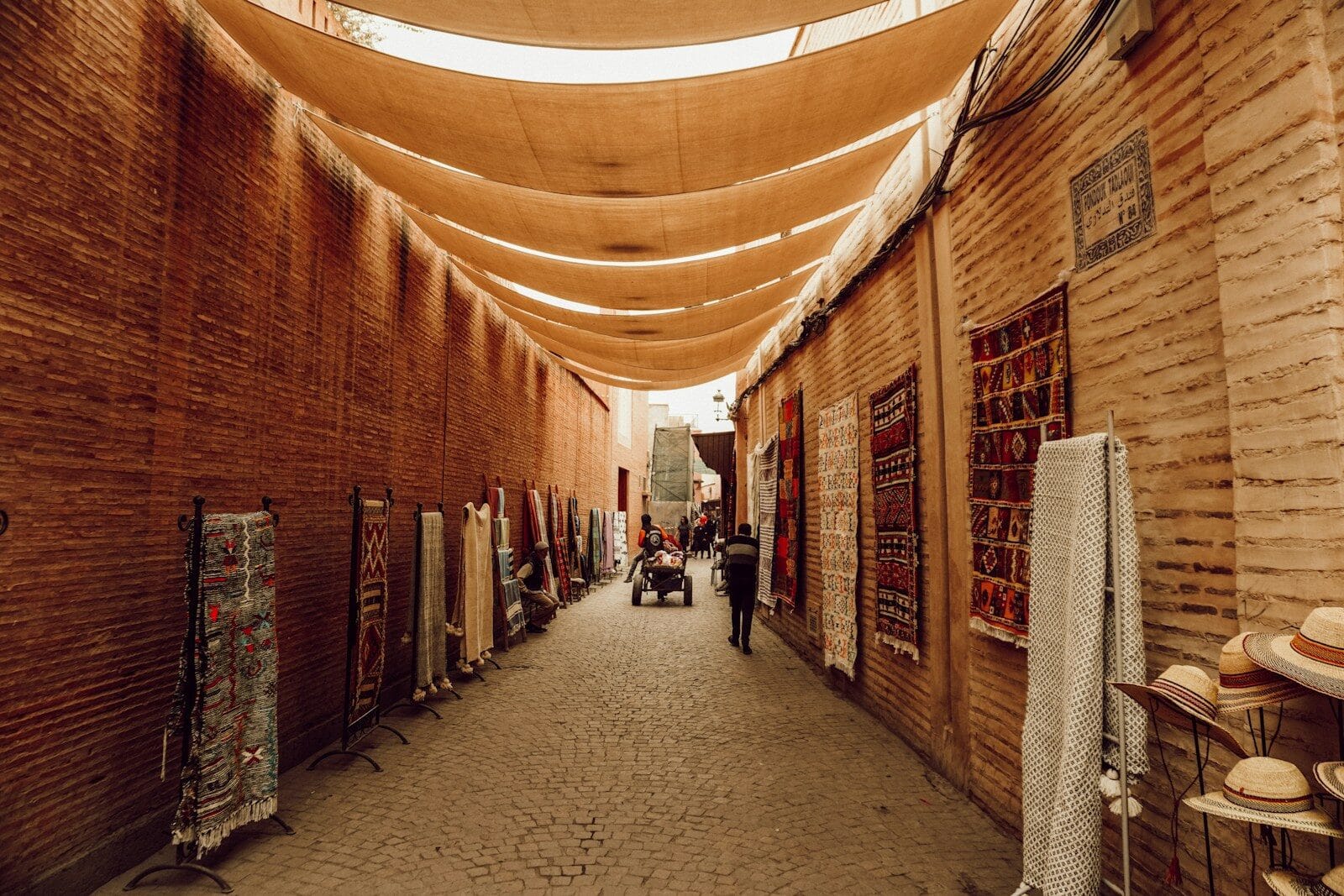
Walking into a souk in Marrakech for the first time, you might catch a snippet of conversation that sounds like Arabic, then notice a French word slip in, followed by something that sounds like nothing you recognize at all. Welcome to Darija. The Moroccan Arabic language characteristics that make this dialect both fascinating and a little disorienting become obvious within minutes once you start paying attention. Understanding even a small slice of how Moroccans actually speak makes traveling here with kids feel less like guesswork and more like genuine connection.
This guide walks through what Darija really is, how it differs from the Arabic you may have heard in films or on the news, why French and Berber sit comfortably alongside it, and which phrases your family can learn before the plane lands. We will also look at the regional accents you will hear between Casablanca, Marrakech, Fes, and the south, plus how to handle everyday moments like ordering breakfast, asking for directions, and bargaining with shopkeepers. By the end, you will know more about the Moroccan Arabic language characteristics than most first-time visitors ever pick up.
5 Day Solo Female Morocco Escape
Discover Morocco with confidence and ease. Private transfers, safe boutique riads, and thoughtfully designed experiences for solo female travelers who want comfort and peace of mind. Plan Your Solo Trip
10 Day Culture & Desert Adventure for Women
Explore Morocco’s highlights from the Atlas Mountains to the Sahara Desert in a safe and supportive way. Enjoy guided experiences, sunset camel rides, and carefully selected accommodations. Customize Your Journey
11 Day Relaxed Solo Female Retreat
Travel at your own pace through Morocco’s cities and coastal gems. Perfect for solo women seeking relaxation, cultural discovery, and a stress-free experience. Book Your Escape
What Darija Actually Is, and Why It Confuses Even Arabic Speakers
Darija is the everyday spoken language of Morocco. It is what families speak at home, what kids shout across playgrounds, what taxi drivers grumble in traffic, and what comedians use on YouTube channels with millions of subscribers. Linguists place it under the umbrella of Maghrebi Arabic, a regional branch that also covers Algeria, Tunisia, Libya, and Mauritania.
Here is the part that surprises most visitors. An Arabic teacher from Cairo or a journalist from Beirut can land in Casablanca and struggle to follow a regular conversation. The Moroccan Arabic language characteristics responsible for this gap include heavy vowel reduction, dense consonant clusters at the start of words, and vocabulary borrowed from Berber, French, and Spanish in ways that other Arabic dialects simply do not have.
Think of it this way. Modern Standard Arabic is what news anchors read off teleprompters. Darija is what those same anchors switch to the second the broadcast ends. It is the living version of the language, full of slang, jokes, and shortcuts that no textbook bothers to teach. Most Moroccans can understand other Arabic dialects from films and TV, but the reverse rarely holds. Egyptian content gets exported across the Arab world. Moroccan content tends to stay within the Maghreb, which keeps Darija fairly insulated.
For families traveling in Morocco, the takeaway is practical. Even if one parent has studied some Arabic, expect a learning curve. The good news: Moroccans are used to this and almost always patient with visitors trying out a few words. They will switch to French, Spanish, or English the moment they sense you are stuck.
The Building Blocks of Darija: Berber, Arabic, French, and Spanish
To understand the Moroccan Arabic language characteristics that make Darija sound the way it does, you have to look at the layers underneath. This is not a language that grew in isolation. It absorbed influences from every group that passed through or settled in this corner of North Africa.
The Amazigh or Tamazight (Berber) Foundation
Long before Arabic arrived in the seventh century, people living here spoke Tamazight, the language of the Amazigh, often called Amazigh people (Berbers) in older literature. That language never disappeared. It still shapes Darija in real ways. Words for plants, animals, traditional foods, and household items often come from Tamazight roots. The very rhythm of how Moroccans clip words and crash consonants together carries a Berber fingerprint that other Arabic dialects lack.
If you spend any time in the Atlas Mountains or along the Sahara fringe, you will hear Tamazight spoken outright. In 2011, Morocco recognized it as an official language alongside Arabic, and you now see it on government buildings and road signs in its own beautiful Tifinagh script.
French and Spanish Loanwords
Then came the European influences. France controlled most of Morocco from 1912 to 1956, and Spain controlled the north and parts of the south. Those decades left a mark you can hear in almost every Darija sentence today.
A Moroccan might say la cuisine for kitchen, le téléphone for phone, or simply mix in a French verb conjugated with Arabic prefixes. In northern cities like Tetouan or Tangier, Spanish words show up far more often. Bocadillo (sandwich), cocina (kitchen), and semana (week) pop up regularly.
This is one of the Moroccan Arabic language characteristics that makes Darija feel modern and quick. Speakers reach for whichever word lands best, regardless of origin, and nobody bats an eye.
What is the main language of Morocco?
The main language of Morocco in daily life is Darija, the local Moroccan Arabic dialect. Officially, however, the country recognizes Modern Standard Arabic and Tamazight (Berber) as its two national languages. Most Moroccans grow up speaking Darija at home and learning Standard Arabic, French, and often English at school.
What language do they speak in Morocco besides Arabic?
Beyond Arabic, the most widely spoken languages are Tamazight (Berber), French, Spanish (especially in the north), and increasingly English. The Moroccan French language influence remains strong in business, healthcare, and higher education, while Spanish dominates parts of the northern coast.
Why Modern Standard Arabic Speakers Find Darija Difficult
If you have ever studied formal Arabic, you might assume Morocco will be straightforward. It will not be. The grammatical and phonetic gulf between Modern Standard Arabic and Darija is wider than most people expect, and it catches even native speakers from other Arab countries off guard.
Among the most striking Moroccan Arabic language characteristics: Darija drops short vowels in places where MSA keeps them, producing word starts like kt-b (he wrote) or ms-kn (poor) that feel almost unpronounceable to outsiders. Verb conjugation is simpler in some ways, with the future tense formed by adding ghadi before a verb and the present continuous formed by adding ka- or ta- as a prefix. Negation works by sandwiching the verb between ma and sh, similar to Egyptian Arabic but with different vocabulary in the middle.
Numbers above ten get tricky. Telling time and counting money in Darija requires a separate study session that most travelers never do. This is why main language in Morocco debates often confuse outsiders. Officially, the answer is Arabic. In daily practice, the answer is Darija, which is technically a dialect but functions as its own spoken language.
Multilingual Morocco: What Languages Do They Speak in Morocco
Ask a Moroccan friend what languages they speak in Morocco and you will probably get a list of four or five. Most people grow up hearing several at once, and switching between them feels normal rather than impressive.
Modern Standard Arabic
Used in schools, official documents, news broadcasts, and religious settings. Almost no one speaks it casually. If you address a Moroccan stranger in textbook Arabic, expect a smile and a switch to something easier.
Tamazight (Berber)
Around a third of the population speaks one of three main Tamazight varieties: Tarifit in the north, Tamazight in the Middle Atlas, and Tashelhit in the south. Since 2011, Tamazight has shared official status with Arabic.
Moroccan French Language
French is the lingua franca of business, science, medicine, and higher education. Highway signs, restaurant menus, and bank statements often appear in French alongside Arabic. The Moroccan French language style has its own flavor, with borrowed Darija words and a clipped pronunciation that sounds different from Parisian French. For families, this is genuinely useful: if you have any school French at all, you can navigate most cities comfortably.
Spanish in the North
In Tangier, Tetouan, Chefchaouen, and the surrounding region, Spanish remains common, especially among older residents. You will see Spanish satellite TV in cafes and hear it traded across counters in markets.
English on the Rise
English has been climbing fast among younger Moroccans, especially in tourism, tech, and the Marrakech and Casablanca scenes. Hotel staff, riad managers, and most guides working with families speak solid English. In smaller villages, less so.
Are Moroccan Arabic language characteristics very different from other Arabic dialects?
Yes. The Moroccan Arabic language characteristics include reduced vowels, consonant clusters, and a large pool of Berber, French, and Spanish loanwords that are not present in Egyptian, Levantine, or Gulf Arabic. Most other Arab speakers find Darija difficult to follow on first hearing.
What is the national language of Morocco according to the constitution?
Since the 2011 constitutional reform, Morocco officially recognizes two national languages: Arabic and Tamazight. Darija, the spoken Moroccan Arabic, is not listed separately because it is treated as a dialect of Arabic, even though it functions like its own language in everyday life.
What Is the National Language of Morocco, Officially?
This question comes up constantly, and the answer is layered. The Moroccan constitution names two official languages: Arabic and Tamazight. So when people ask for the national language of Morocco, both answers are technically correct.
In practice, though, the main language of Morocco spoken on the street is Darija. It is not officially recognized in the constitution because the state considers it a dialect rather than a separate language. Linguists tend to disagree, pointing out that Darija has its own grammar, vocabulary, and sound system that mark it apart from MSA.
You will sometimes see Darija written in informal contexts: text messages, social media, comedy scripts, and a small but growing body of literature. There is no single standardized way to write it, and you will see the same word spelled three different ways in three different posts. Some writers use Arabic script, others use Latin letters with numbers standing in for sounds that do not exist in English (3 for the ayn sound, 7 for a hard h, 9 for a guttural q).
For families traveling here, the question of what is the national language of Morocco matters less than knowing that Darija is what you will actually hear. A few words of it will carry you a long way.
Planning a family trip to Morocco? Morocco Family Vacation designs custom private Morocco tours for families, with child-friendly experiences, trusted local guides who help bridge any language gaps, and comfortable stays from the medinas of Fes to the dunes of the Sahara. Plan Your Family Adventure with people who know the country and its languages from the inside.
Ready to Start Your Morocco Journey?
Let us help you design a smooth, affordable, and memorable journey crafted by local travel experts who know Morocco best.
What language is spoken in Casablanca, Morocco?
The Casablanca Morocco language environment is dominated by Darija, with heavy use of French in business and middle-class settings. You will also hear Modern Standard Arabic in formal contexts and English in tourism and tech sectors. Spanish and Tamazight are present but less common than in northern or southern regions.
Casablanca Morocco Language: Why the Big City Sounds Different
The Casablanca Morocco language experience is its own thing. As Morocco’s economic capital, Casablanca pulls in workers and families from every region, which means you hear a softer, more French-leaning Darija than you do in older cities like Fes or Meknes.
In Casablanca, French slips into casual conversation more often than anywhere else in the country. A teenager describing their weekend might use three Darija sentences and toss in five French words without blinking. Business meetings often happen entirely in French, with Darija reserved for jokes and small talk.
Compare that to Marrakech, where the Moroccan Arabic language characteristics lean more toward a southern accent, with stronger Tamazight influence and slower vowels. Or Fes, where the local accent is considered the most refined and traditional, often described as the “old-money” version of Darija. In the Rif Mountains and along the northern coast, Spanish loanwords mix in heavily. Down in the deep south, you encounter Hassaniya Arabic, which sits closer to the Arabic spoken in Mauritania than to standard Darija.
For families, the practical implication is small but useful. If your kids pick up a few phrases in one city, those same phrases work everywhere, but the accent and pace will shift as you move around. Children often catch on to this faster than adults, mimicking the new sounds before parents have noticed the difference.
Essential Moroccan Language Phrases for Family Travelers
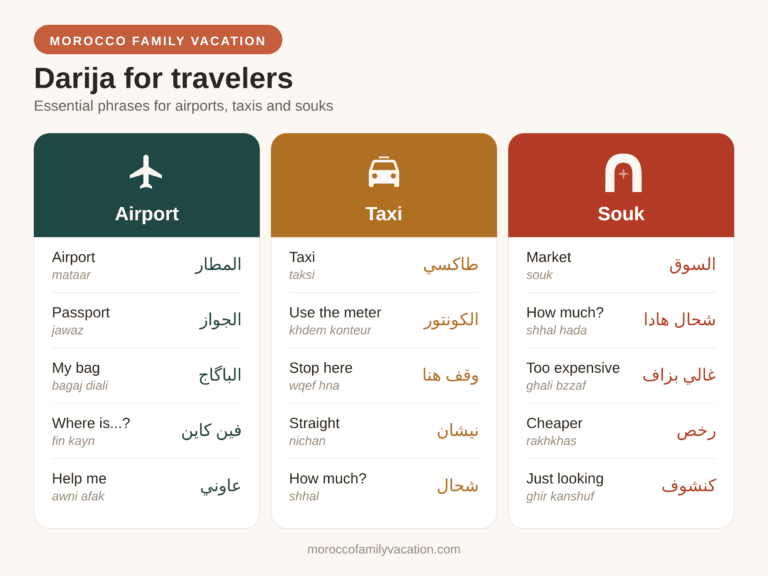
Knowing a handful of Moroccan language phrases changes how locals respond to you. It is not about fluency. It is about the small effort that signals respect.
Greetings and Politeness
- Salam alaykum (peace be upon you): the universal hello
- Wa alaykum salam: the standard reply
- Labas? (you good?): a casual “how are you”
- Hamdullah (praise God): the standard “I am fine”
- Shukran (thank you): goes a long way
- Bslama (goodbye)
- Smahli (excuse me, sorry)
At the Market or Restaurant
- Bghit… (I want…): start any food order with this
- Shhal hada? (how much is this?)
- Bzzaf (a lot, too much): useful when bargaining
- Ghali (expensive): also useful when bargaining
- Ladid (delicious): compliments to the cook
- Ma kayn mushkil (no problem)
Phrases Your Kids Will Love
- Wakha (okay): kids pick this up in a day
- Yallah (let’s go): another fast favorite
- Lalla, Sidi (madam, sir): polite address for adults
- Habibi, Habibti (my dear, masculine and feminine): a warm word older Moroccans often use with children
A small notebook with these written out, or a phone screenshot, helps a lot. Kids especially enjoy practicing on shopkeepers, and shopkeepers nearly always reward the effort with a smile, an extra olive, or a small piece of candy.
Code-Switching: Three Languages in a Single Sentence
One of the most distinctive Moroccan Arabic language characteristics is how casually speakers move between Darija, French, and sometimes Spanish or English in a single conversation, often within a single sentence. Linguists call this code-switching, and Morocco is one of the most code-switched societies on the planet.
- A typical exchange might go: “Bghit ndir une réservation pour deux personnes, tomorrow if possible.” That is Darija for “I want to make,” followed by French for “a reservation for two people,” followed by English. Nobody finds this strange. It happens hundreds of times a day in cafes across the country.
For families, this can feel confusing for about ten minutes and then weirdly helpful. If your French is decent, you will catch enough words to follow conversations even when you do not understand the Darija parts. Kids often benefit from this too, since they pick up patterns faster than they pick up vocabulary.
If you want to sound less like a tourist, throw a French word into your Darija when you forget the right term. Locals will not mind. They do it themselves all the time.
Practical Tips for Families Using Darija on the Ground
A few small habits make the language side of your trip smoother. Once you understand the Moroccan Arabic language characteristics at play, these become almost automatic.
Lead with a Greeting
Always open with salam alaykum before asking anything, even directions. It is more than politeness. It signals that you respect the person you are talking to, and the response you get back will be warmer because of it.
Let Kids Try First
Children are forgiven everything in Morocco when it comes to language attempts. A six-year-old saying shukran will get a much bigger reaction than a parent saying it perfectly. Use this. Encourage your kids to be the ones who order, ask, and thank.
Keep a Small List on Your Phone
A screenshot of twenty phrases is enough for most travel situations. Add audio if your kids learn better that way. Memrise and a few free YouTube channels offer decent Darija content.
Don't Worry About Perfection
The pronunciation of letters like ayn, ghain, and the throaty qaf takes years to learn properly. Moroccans expect tourists to mangle these and will fill in the gaps from context. Effort matters more than accuracy.
Listen for Numbers
Numbers in Darija are genuinely hard. Always ask a vendor to write the price down or punch it into a calculator. This avoids confusion and protects you from the rare overcharge.
Need Help with Transportation in Morocco?
Book a reliable private driver for your Morocco family adventure today – personalized routes designed just for you, and get 30% off as a first-time visitor!
Quick Takeaways
- Darija is the everyday spoken language of Morocco, distinct enough from Modern Standard Arabic that other Arab speakers often struggle to follow it.
- The key Moroccan Arabic language characteristics include heavy vowel reduction, consonant clusters, and vocabulary borrowed from Berber, French, and Spanish.
- Morocco has two official languages: Arabic and Tamazight (Berber), recognized since 2011.
- French is widely used in business, education, and city life, especially in Casablanca and Rabat.
- Spanish remains common in the north, around Tangier, Tetouan, and Chefchaouen.
- Code-switching between Darija, French, and English is normal and even expected.
- A handful of Darija phrases like salam alaykum, shukran, and bzzaf will improve every interaction with locals.
Conclusion: Speaking a Little Goes a Long Way
You do not need to master Darija to have a wonderful family trip in Morocco. You just need enough to crack a smile, ask a question, and thank someone properly. The Moroccan Arabic language characteristics that make this dialect distinct also make it inviting in a way few languages are. Moroccans love hearing visitors try, even when the pronunciation is off, and they reward the effort with patience, generosity, and often a free cup of mint tea.
The deeper magic of traveling here is that language stops being a wall and becomes a doorway. Your kids will pick up yallah and wakha by day three. You will find yourself slipping French into Arabic without thinking. By the end of the trip, conversations will feel less like translation and more like collaboration.
Ready to put this into practice? Morocco Family Vacation designs custom private Morocco tours built around families, with child-friendly experiences, trusted local guides who handle the language for you when needed, and comfortable stays from the medinas to the Sahara. Plan Your Family Adventure with a team that knows how to introduce kids to Morocco in a way that feels safe, fun, and memorable. Bring the phrases. We will handle the rest.
─── Your questions, our answers.
Frequently Asked Questions
Our dedicated team is here to answer your Morocco Travel questions and ensure a smooth, memorable journey through Morocco.
What is the main language of Morocco?
A common way to say hello in Morocco is “Salam” or the fuller greeting “Salam Alaikum,” which means peace be upon you. It is widely used in both casual and respectful settings. Friends may also greet each other with simple informal expressions depending on region and familiarity. In tourist areas, many people also use “Bonjour,” “Hello,” or other greetings when speaking with visitors. Moroccans often greet warmly and may ask about your well-being as part of normal politeness. Learning “Salam Alaikum” is useful for travelers because it is understood across the country and is a respectful, friendly way to greet people.
What are the top 3 languages in Morocco?
The three most important languages in Morocco are Moroccan Arabic, Amazigh, and French. Moroccan Arabic is the main spoken language used in everyday life across most of the country. Amazigh, which includes several regional varieties, is also an official language and is widely spoken in many communities. French is not an official national language, but it remains very important in business, education, media, and administration. In some regions you may also hear Spanish, and English is growing in tourism and among younger people. For most visitors, the main languages they will encounter are Arabic, Amazigh, and French.
Do Moroccans speak more French or Arabic?
Moroccans speak Arabic far more than French in everyday life. Moroccan Arabic is the main spoken language used at home, in shops, in neighborhoods, and in daily communication. French is widely understood and often used in schools, business, official documents, and some urban professional settings, but it is usually a second language rather than the primary language people speak with family and friends. In major cities you may hear French often, which can give visitors the impression it dominates, but Arabic is much more commonly spoken overall. If comparing daily use among the population, Arabic is clearly spoken more than French in Morocco.
Kate Carter
Family Travel Blogger
Kate Carter is a mom and travel blogger who fell in love with Morocco’s culture and warmth. Through Morocco Family Vacation, she shares tips and stories to help travelers enjoy authentic, stress-free experiences. Join us along the way.
Table of Contents
Our Services
-
Private Family Tours
-
Custom Itineraries
-
Sahara Desert Tours
-
Chefchaouen & Northern Morocco Tours
-
Luxury Desert Camping
-
Multi-Day Tours (2–16 Days)
-
Atlas Mountains Trips
-
Cooking Classes & Market Visits
-
Photography & Heritage Tours
-
Airport Transfers & Private Transport
-
Custom Birdwatching Tour in Morocco
-
24/7 Tour Support & booking Flexibility
At Morocco Family Vacation, we create custom Morocco tour packages designed around your interests and travel style. As a dedicated and independent travel agency, we specialize in private Morocco tours offering memorable desert adventures, cultural experiences, and family friendly itineraries while delivering attentive, personalized service from start to finish.
Popular Tours
Latest Posts
#Morocco in February
#Morocco weather in February
#February temperatures in Morocco
#Weather in Morocco in February
#Morocco travel guide February