
Moroccan Tile Work
How centuries-old craftsmanship of Moroccan Tile Work continues to shape modern Moroccan architecture and décor.
Moroccan Tile Work the beauty, history, and modern charm
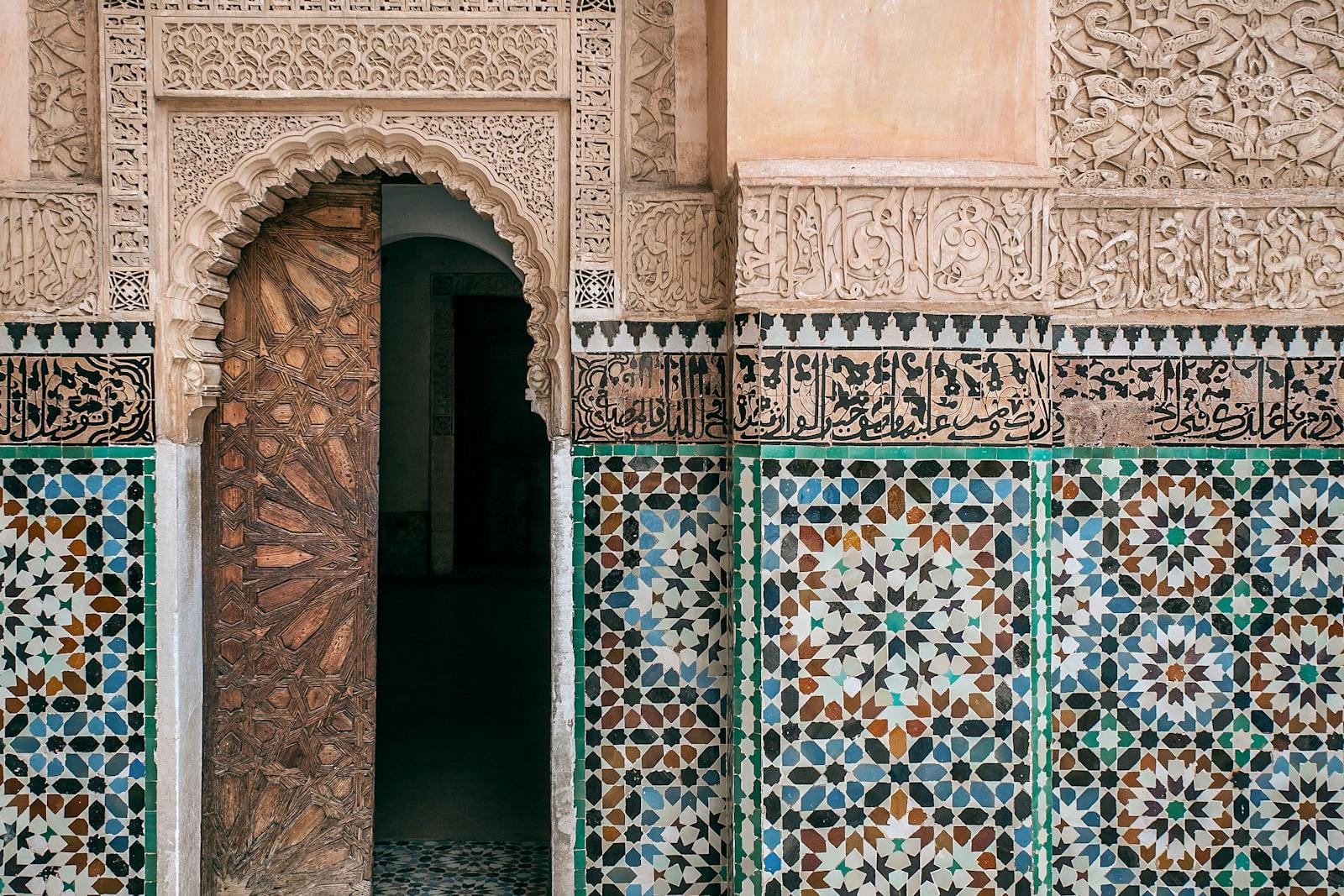
Push open the wooden door of the Ben Youssef Madrasa in Marrakech and the first thing that hits you is not the courtyard or the cedar ceiling. It is the walls. Thousands of tiny hand-cut ceramic pieces arranged in mathematical patterns that repeat, invert, and interlock without ever quite showing you the trick. The Moroccan tile work in this building has been there since the 16th century, and it still stops people mid step 500 years later.
This guide walks you through what Moroccan tile work is, what it is called (zellige), where it came from, how it is still made by hand in Fes and Meknes, what to look for when you buy it, how much it costs, and where to see the finest examples during a trip. It also covers the practical side for readers thinking about installing zellige at home: the downsides no one talks about, the mistakes tile setters make, and how the imperfections that define good zellige are the same thing that scares off some homeowners.
Quick takeaways
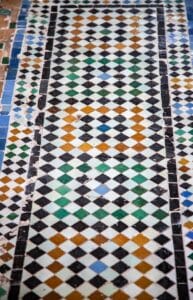
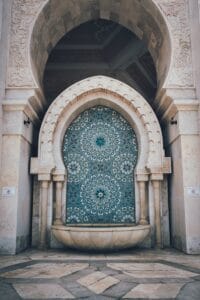
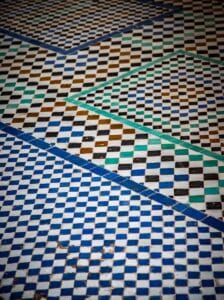
- Moroccan tile work is called zellige (or zellij), from the Arabic word “zalij” meaning tile. It is small hand-cut glazed pieces assembled into geometric patterns.
- Fes is the center of the craft. Workshops in Ain Nokbi have been making zellige since the 10th century, using gray Miocene clay dug from the hills around the city.
- The process is entirely by hand. Tiles are fired, glazed, then chipped into shapes with a small hammer called a menqach, and assembled face down before mortar is poured over the back.
- Islamic geometry is the design language. Stars, hexagons, and interlocking polygons repeat because Islamic art traditionally avoids depicting people or animals.
- The best places to see historic zellige are the Medersa el-Attarine in Fes (14th century), the Ben Youssef Madrasa in Marrakech (16th century), and the Mausoleum of Moulay Ismail in Meknes (18th century).
- Prices at Moroccan workshops start around 800 MAD per square meter for standard patterns and climb to 3,000 MAD per square meter for elaborate custom designs.
- Imperfection is the point. Real zellige has visible variations in color, cut, and thickness. Perfectly uniform tiles are machine printed, not zellige.
What is Moroccan tile?
Moroccan tile, known as zellige (or zellij), is small hand-cut glazed terracotta pieces assembled into geometric mosaic patterns, a craft that has been made by hand in Morocco since the 10th century. Each finished panel is made from anywhere between a few hundred and several thousand individual pieces called tesserae.
The tile itself starts as gray Miocene clay dug from hills around Fes. Artisans shape the clay into squares, dry it in the sun, fire it in wood-burning kilns, glaze one side with metallic pigments, then chip the fired tile into precise geometric shapes using a hammer with a beveled blade called a menqach. The cut pieces are arranged face down on the floor, and mortar is poured over the back to bind them into a single panel that can be lifted and mounted on a wall.
This is why zellige looks different from any factory tile. The color varies from piece to piece because of small differences in the kiln temperature. The edges are slightly uneven because they were chipped by hand rather than cut by machine. The joints between pieces are tighter than any machine can produce, because a skilled cutter matches each piece to its neighbor by eye.
The style used in Morocco today grew out of Roman and Byzantine mosaic traditions, adapted through the Islamic period into the geometric patterns you see now. Because traditional Islamic art avoids images of people and animals, zellige artisans developed a mathematical vocabulary of stars, hexagons, and interlocking polygons that carries symbolic meaning about divine order and unity.
Practical takeaways:
- Real zellige is always hand cut. If the tiles are perfectly identical, they are printed replicas.
- The gray Miocene clay from Fes is the traditional source and still the standard for authentic pieces.
- Colors vary within a single panel. This is expected, not a defect.
- Look for the term “zellige zwak” for the highest grade of hand cut work.
- Prices start around 800 MAD per square meter for genuine Moroccan zellige.
For families visiting Morocco, Morocco Family Vacation arranges private workshop visits in Fes where kids can watch artisans chip tiles and see a full panel assembled from start to finish.
A short history of Moroccan tile work
The story of Moroccan tile work begins in the 10th century in the city of Fes, during the Idrisid dynasty. Early tiles were plain, colored in muted earth tones like white, brown, and ochre. The craft evolved out of Roman and Byzantine mosaic traditions that were already familiar across North Africa, but Islamic artisans reshaped it entirely.
By the 13th century, under the Marinid dynasty, zellige had become one of the defining features of major Moroccan architecture. Marinid rulers built madrasas (religious schools), mosques, and palaces in Fes, Meknes, and Marrakech, and they covered the walls of these buildings in complex geometric mosaics. The Medersa el-Attarine in Fes, built in 1325, shows what the peak of Marinid zellige looked like, and much of the original tile is still on the walls today.
Two things drove the design system. First, Islamic art traditionally avoids depicting sentient beings, which pushed artisans toward geometry rather than figurative art. Second, the mathematics of interlocking polygons carried theological meaning about the unity and infinity of the divine. Master craftsmen were trained in both practical tile cutting and the underlying geometric logic.
The color palette grew over the centuries. Early zellige used earth tones because those were the only pigments the artisans could reliably fire. By the 14th century, advances in glazing brought in cobalt blue, emerald green, and saffron yellow. Persian artisans had discovered in the 9th century that tin oxide made glaze opaque, and that discovery reached Morocco through Andalusia and made colored zellige possible.
The Hispano-Moresque period between 711 and 1492 spread Moroccan tile work into southern Spain. The Alhambra in Granada, finished in the 14th century, is essentially a Moorish palace covered in zellige made using techniques identical to those still used in Fes today. When the Reconquista drove Muslim artisans out of Spain, many of them returned to Morocco and reinforced the tradition there.
Today, most authentic zellige still comes from workshops in Ain Nokbi, the potters’ quarter outside the Fes medina, and from smaller workshops in Meknes and Tetouan.
How zellige is made
The zellige process has seven main steps and takes several weeks from raw clay to finished panel. Every step is done by hand.
Step 1: The clay. Gray Miocene clay is dug from the hills around Fes, brought to the workshop, and kneaded by hand or with foot pressure to remove air pockets. This clay has a specific mineral composition that makes it strong enough for cutting after firing.
Step 2: Shaping. The clay is pressed into wooden molds and cut into rough square tiles about 10 cm on a side. These are then set out on the ground to dry in the Fes sun for a week or two.
Step 3: First firing. The dried tiles are stacked in kilns fueled by olive pits and wood, and fired at around 800 to 900 degrees Celsius. This produces plain terracotta tiles called bejmat.
Step 4: Glazing. One side of each tile is dipped in a colored glaze mixed with tin oxide. Traditional colors include white, cobalt blue, emerald green, saffron yellow, ochre, and black.
Step 5: Second firing. The glazed tiles go back into the kiln for a second firing that fuses the glaze to the terracotta. After cooling, each tile is a hard, glossy plate ready for cutting.
Step 6: Hand cutting. The apprentice cutter traces a shape onto the glazed side, then chips away the excess with a small hammer called a menqach. Common shapes include stars (najma), hexagons (sittiya), triangles, and interlocking curves. A trained cutter can chip 500 to 1,000 shapes in a day.
Step 7: Assembly. The cut pieces are laid out face down on a flat surface following a master pattern (called a khat) drawn on paper. Mortar is poured over the back, iron rods are sometimes embedded for reinforcement, and the whole panel is left to set. Once dry, the panel is flipped over and mounted on a wall.
Why the imperfections matter
The color variation, the slightly uneven joints, and the small irregularities in each piece are what tell the eye it is looking at handwork. A machine can make a flat wall of glossy geometric tile that costs a tenth of the price. It just does not look the same, and anyone who has been in a room with real zellige can pick out the difference in a second.
Types of Moroccan tile
Not all Moroccan tile is zellige. Several other tile types are common in Moroccan interiors, and understanding the differences helps you shop and specify smart.
Zellige (zellij): Small hand-cut glazed pieces assembled into geometric mosaic. Fired in Fes. This is the traditional craft covered in the sections above.
Bejmat: Long, narrow, hand-formed unglazed terracotta tiles, typically 15 by 5 cm, used for floors and low walls. Common in riad courtyards and pool surrounds. Warmer and more rustic than zellige.
Tadelakt: Not exactly a tile but often listed alongside them. Tadelakt is a lime-based plaster polished with black soap and pressed with stones. It gives walls and floors a smooth, waterproof, slightly waxy finish. Used in hammams (Moroccan bathhouses) and increasingly in modern bathrooms worldwide.
Painted tile (moucharabieh style): Machine-made square tiles with painted patterns, often in blue and white. Cheaper than zellige and used in many modern Moroccan homes and hotels. Not authentic Fes craftwork but genuinely Moroccan in style.
Cement tile (carreaux ciment): Colored cement tiles pressed with metal molds, common in early 20th century French colonial buildings across North Africa. Distinct from zellige but sometimes confused with it in export markets.
What tile suits which room
- Floors and pool surrounds: bejmat or cement tile (zellige is too fragile for high traffic floors)
- Walls in kitchens or bathrooms: zellige panels or painted tile
- Feature walls or fireplace surrounds: zellige panels
- Wet rooms and hammams: tadelakt
- Outdoor terraces: bejmat or frost-resistant cement tile
Where to see the best Moroccan tile work
The most impressive Moroccan tile work is in old religious and royal buildings, most of which are open to visitors. If you have any interest in the craft, plan visits around these:
Medersa el-Attarine, Fes (built 1325). One of the finest examples of Marinid zellige in the country. The central courtyard walls are covered in intricate star and polygon patterns in cobalt blue, green, and white. Small building, easy to see in 30 to 45 minutes.
Bou Inania Madrasa, Fes (built 1350s). Larger than Attarine and equally decorated. Combines zellige at the base with carved stucco and cedar wood above. The transition between the three surface materials is the classic Marinid style.
Ben Youssef Madrasa, Marrakech (built 16th century). The largest madrasa in Morocco. Zellige covers most vertical surfaces of the central courtyard. Closed for restoration for several years, reopened in 2022. Now one of the busier tourist stops in Marrakech.
Mausoleum of Moulay Ismail, Meknes (built 1703). Free to visit for non-Muslims (rare for a mausoleum in Morocco). The zellige inside the main chamber is 18th century work in a slightly different style, with more elaborate central star patterns.
Bahia Palace, Marrakech (built 1866 to 1900). Not as old as the madrasas but shows how 19th century zellige had evolved. More color, more variation in patterns from room to room.
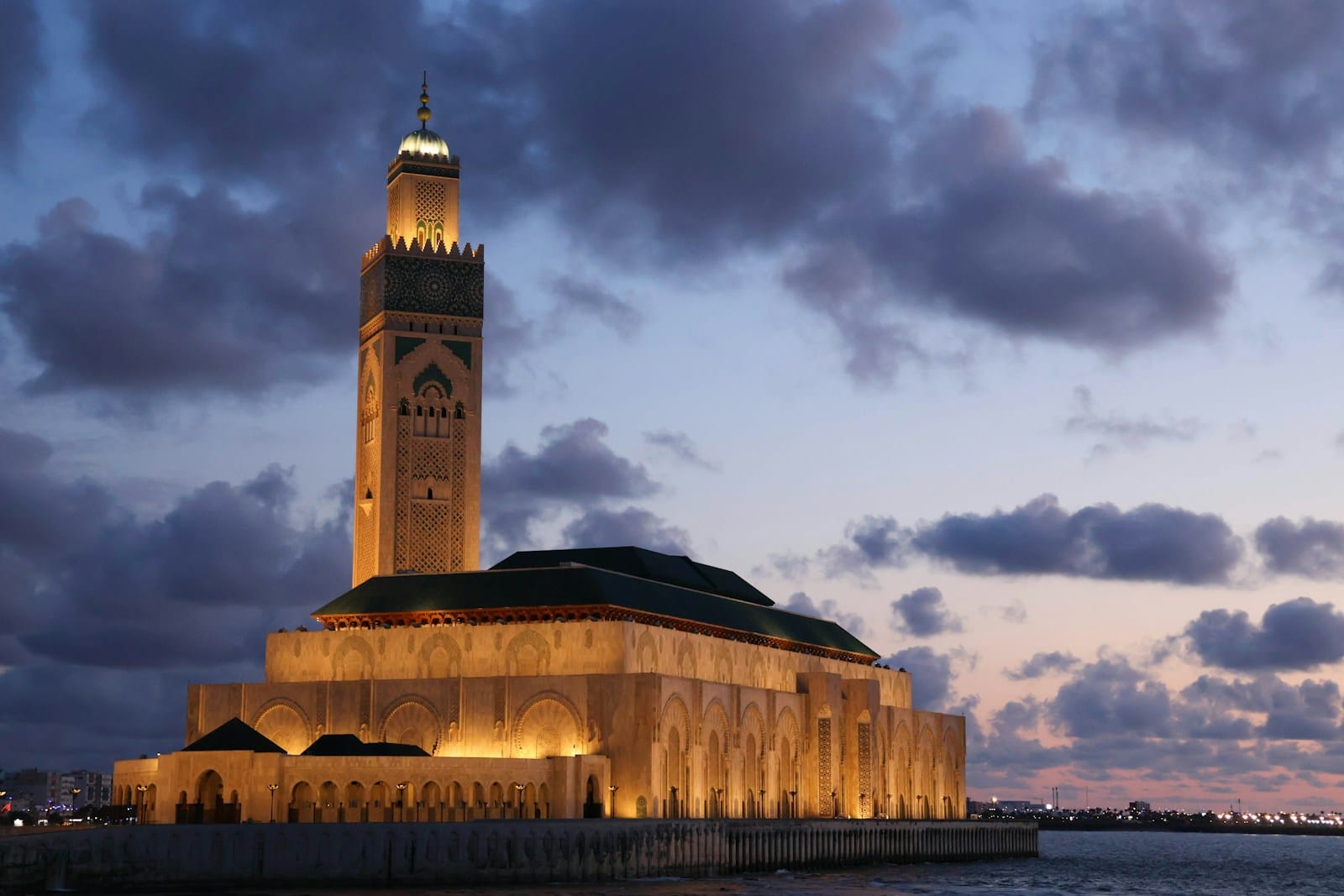
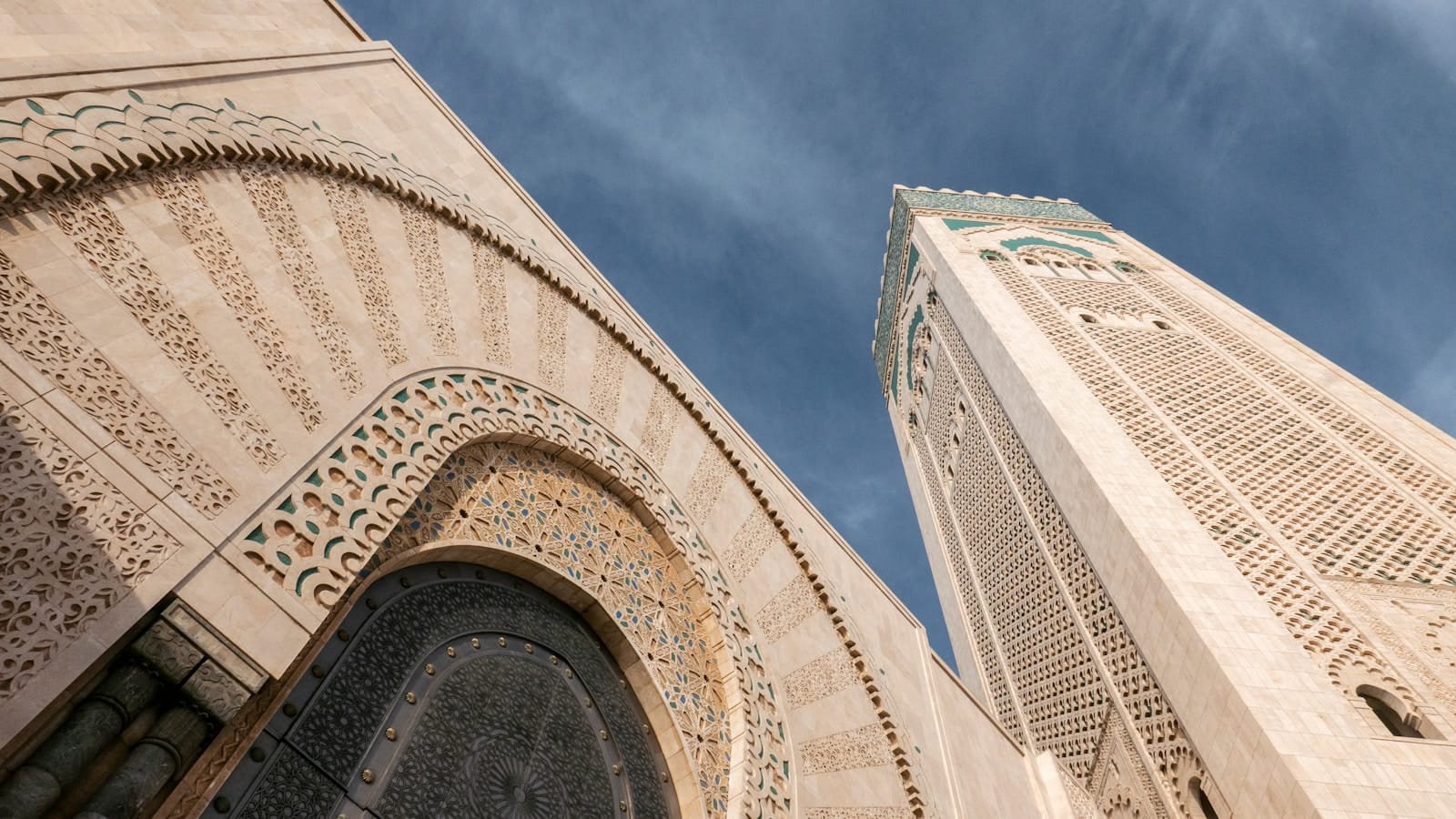
Hassan II Mosque, Casablanca (built 1993). Modern zellige on an enormous scale. Guided tours available for non-Muslims. The mosque used artisans from every zellige workshop in the country during construction.
Nejjarine Fountain, Fes (17th century). Free to see on the outside. Small but perfect example of fountain-scale zellige.
For families, the Bahia Palace in Marrakech is the easiest first stop with kids. Big open courtyards, less climbing, more variety in patterns to keep children engaged.
Where to buy zellige tile
If you want to buy zellige to install at home or to bring back small pieces as souvenirs, Fes is the obvious source. Marrakech, Meknes, and Tetouan also work.
Ain Nokbi, Fes: The pottery and zellige quarter just outside the Fes medina walls. Free to visit. Many workshops run tours and sell direct. Prices start around 800 MAD per square meter for basic patterns and climb to 3,000 MAD per square meter for elaborate custom work.
Meknes workshops: Smaller scene, near the Bab Mansour gate. Less touristy than Fes. Better for bulk orders because negotiation is easier.
Marrakech: Several showrooms in Guéliz (the modern quarter) and around the medina. Prices run 20 to 40 percent higher than Fes for equivalent pieces.
Online importers: If you cannot travel, established importers like Zia Tile in the US and Bert & May in the UK bring in genuine Fes zellige. Prices roughly double what you would pay at the source.
What to ask when buying
- Is this hand cut zellige or machine-made replica?
- What is the clay source? (Fes Miocene clay is the answer you want)
- Are the pieces cut individually or scored and snapped?
- Can I see samples from the same batch to check color consistency?
- Do you handle export shipping and customs paperwork?
Shipping tile home
Zellige is heavy. A single square meter of assembled panel weighs roughly 20 to 30 kg. Shipping is typically by sea freight in wooden crates, with lead times of six to twelve weeks depending on destination. Air freight is available but expensive, usually only justified for small orders under two square meters.
Are Moroccan tiles still in style?
Yes, Moroccan tiles are still very much in style, and demand from international designers has been growing steadily since the mid 2010s. The scaled-back “wabi sabi” and “quiet luxury” trends of the 2020s pushed zellige further into mainstream residential design, especially in kitchens and bathrooms.
Instagram and Pinterest drove the initial surge. Designers like Kelly Wearstler and Amber Lewis featured zellige heavily in their published projects. Hotel groups like the Ace, Soho House, and Rosewood used zellige in flagship properties, which pulled the material into hospitality specifications worldwide.
However, tastes shift. Some regional markets have moved past the peak zellige moment and now favor more restrained materials. If you install zellige purely because it is trending, the timing may already be off in your area. If you install it because you like the handmade look and the way light catches uneven glaze, it will outlast the trend cycle.
Practical takeaways:
- Zellige is still selling strongly in North American, European, and Middle Eastern residential design
- Kitchen backsplashes and bathroom walls are the two most common installations
- Neutral colors (white, cream, sage) have overtaken bright cobalt as the most requested palette
- Trend fatigue is starting in high-end Los Angeles and London markets
- Buy for love, not trend. A well-installed zellige wall will outlast any current design cycle
Ready to Start Your Morocco Journey?
Book your trip today with our expert planners, enjoy personalized itineraries tailored to your flights and travel needs, and claim 30% off as a first-time visitor!
What are the downsides of Moroccan tiles?
Zellige has real trade-offs, and no honest guide should skip them. If you are considering installing it, here is what your tile setter probably will not volunteer.
Fragility: Zellige is thinner and more brittle than standard porcelain or ceramic tile. It chips at the edges during installation and cannot handle heavy floor traffic. Use it on walls, not floors.
Installation cost: Hand-cut tile requires a hand-fit installation. Standard tile setters often refuse zellige work or charge double. Budget 300 to 500 USD per square meter for skilled installation labor in North America.
Grout headaches: The uneven edges of hand-cut zellige mean the grout joints are inconsistent. Standard grout applications look wrong. Use a grout color close to the tile color to hide the width variation.
Color inconsistency: Zellige tiles from the same batch can vary 10 to 20 percent in shade. This is expected. Buyers unprepared for it call the shipment defective and demand refunds. Order 15 to 20 percent extra to allow for mid-installation color adjustment.
Water and cleaning issues: Zellige is not fully waterproof, and the glaze can stain from acidic cleaners. Use only pH-neutral cleaners. Never bleach, never vinegar.
Long lead times: Custom zellige orders take six to twelve weeks from Fes. Add another two to eight weeks for shipping. Total: three to five months from order to arrival in most Western markets.
Cost per square meter: All in, expect 400 to 800 USD per square meter installed in North America or Western Europe. That includes tile, shipping, labor, and grout.
None of this makes zellige a bad choice. It just means it is not the same as buying tile at a big-box store.
How to tile Moroccan tiles
Installing zellige is different from installing standard tile. If your contractor has never worked with it, either hire someone who has or expect a rough result.
Substrate preparation: The wall must be perfectly flat. Any irregularity shows through hand-cut tile because the pieces are thinner than standard tile. Skim coat the wall with a leveling compound if needed.
Adhesive: Use a white polymer-modified thinset. Standard gray thinset can show through the joint gaps and stain the light glazes.
Setting the tiles: Zellige is set with almost no grout joint. The pieces butt against each other with a joint of 1 to 2 mm maximum, filled with the same white thinset used as adhesive. This is called a “flush set” or “grout-in-adhesive” installation.
Cutting on site: Some cutting is inevitable. Use a wet tile saw with a sharp diamond blade at a slow feed rate. Zellige chips easily under fast cuts.
Sealing: After installation and before use, seal the tile with a penetrating sealer designed for glazed ceramic. This helps with staining but does not make the tile fully waterproof.
Timing: Zellige tile and grout should not be laid on the same day. Let the tile adhesive cure for at least 24 hours before final finishing. Rushing causes joints to shift and pieces to loosen.
Common tiling mistakes to avoid
- Using standard gray thinset (shows through the joints)
- Trying to grout with normal grout after installation (looks industrial and defeats the flush-set style)
- Cutting with a dry angle grinder (chips too much of the edge)
- Not ordering enough overage (color matching mid-project is impossible)
- Hiring a tile setter unfamiliar with zellige (the labor style is different from standard ceramic)
Moroccan tile work in modern homes
The current move in Western interior design is to use Moroccan tile work as a focal accent, not a whole-room finish. A single feature wall in a kitchen or bathroom does more visual work than four walls of the same tile.
Kitchen backsplashes: The single most common use. Zellige between the counter and the upper cabinets throws warm color and light variation into a space that is often dominated by hard modern materials.
Bathroom vanity walls: A zellige panel behind the mirror gives a bathroom a completely different character. Neutral colors (cream, white, sage) hold up better than saturated colors in a room used daily.
Fireplace surrounds: A traditional and durable use. Zellige holds up well to heat and the vertical mounting suits the material.
Pool surrounds: Not the tile itself but the coping and vertical accents around the pool. Bejmat works better than zellige for the pool deck.
Powder rooms: The whole room can go zellige in small spaces. A 3 square meter powder room in one color of zellige is a strong design move that does not overwhelm.
What does not work
- Zellige on kitchen floors (too fragile for the traffic)
- Zellige in outdoor freeze-thaw climates (the tile can crack)
- Mixing four or more zellige colors in one room (chaotic)
- Zellige next to marble with heavy veining (both materials compete for attention)
Family visits to zellige workshops in Fes
If you are traveling with kids and passing through Fes, a workshop visit in Ain Nokbi is one of the more memorable stops. Kids get to see raw clay, watch artisans hammer tiles, and often try chipping a piece themselves.
What to expect:
- The workshops are working factories, not museums. Kids see the dust, hear the hammering, smell the wood kilns.
- Most workshops give short tours in French or English by an owner or manager.
- Tours are usually free but a small tip (20 to 50 MAD) is polite.
- Ain Nokbi is 15 minutes by taxi from the Fes medina.
What works with kids:
- Watching the tile cutter chip shapes with the menqach
- Seeing the pieces laid out face down for assembly
- Choosing a small souvenir tile to take home (usually 20 to 50 MAD each)
- Standing near the kilns (from a safe distance) to feel the heat
What to watch for:
- Kilns are hot. Keep young kids at a distance.
- The workshop floors have scattered ceramic shards. Closed shoes only, no sandals.
- Some workshops have narrow stairs and platforms. Baby carriers work better than strollers.
Morocco Vacation Planner builds Fes days that include an Ain Nokbi workshop visit alongside the Medersa el-Attarine, giving kids a chance to see raw materials, watch the craft, and then see finished 700-year-old zellige on the walls of a historic building in the same afternoon.
Need Help with Transportation in Morocco?
Book a reliable private driver for your Morocco family adventure today – personalized routes designed just for you, and get 30% off as a first-time visitor!
Final thoughts
The craft behind Moroccan tile work is one of the oldest continuously practiced trades in North Africa. Every wall of zellige you see in a Fes madrasa or a Marrakech palace was chipped one piece at a time by hand, using tools and techniques that have barely changed since the 14th century. Whether you plan to install zellige at home or just want to spend an afternoon looking at 700-year-old work in a Fes courtyard, understanding what you are looking at makes the experience deeper.
For travelers, Fes is the place to see the craft in its home city. Meknes and Tetouan add depth if you have more time. Marrakech has the biggest showpiece buildings for tile viewing, especially the Ben Youssef Madrasa and the Bahia Palace, and Casablanca’s Hassan II Mosque shows what modern zellige looks like at full scale.
For families, the workshops in Ain Nokbi are the sleeper hit of a Fes visit. Kids remember the hammering, the raw clay, and the color pigments long after they forget the itinerary.
Morocco Family Vacation designs Private Family Tours in Morocco for Kids, Teens & Toddlers. Plan your perfect family trip to Morocco with custom private tours built for families traveling with toddlers, kids, and teens. You get family friendly experiences, trusted local guides, and handpicked comfortable stays from the medinas all the way to the Sahara.
─── Your questions, our answers.
Frequently Asked Questions
Our dedicated team is here to answer your Morocco Travel questions and ensure a smooth, memorable journey through Morocco.
What do you call old Moroccan floor tile work?
Old Moroccan floor tile work is called bejmat, a hand-formed unglazed terracotta tile in long narrow rectangles about 15 by 5 cm. Bejmat is used for floors, courtyards, and pool surrounds because it wears better than zellige, which is too fragile for high-traffic ground use. Historic riads and older palaces almost always use bejmat on the floor and zellige on the walls.
Where did the tile work in Morocco originate?
Moroccan tile work originated in Fes in the 10th century during the Idrisid dynasty, evolving from Roman and Byzantine mosaic traditions that were already known across North Africa. The craft was heavily shaped by Islamic influences that reached Morocco through Andalusia, and it reached its peak under the Marinid dynasty in the 13th to 15th centuries. Fes still produces most of the country’s authentic zellige today.
When did Moroccan tilework first become popular?
Moroccan tilework became widely popular in the 13th and 14th centuries under the Marinid dynasty, when rulers built madrasas, mosques, and palaces covered in zellige across Fes, Meknes, and Marrakech. The Medersa el-Attarine, completed in Fes in 1325, is one of the earliest surviving examples of what became the classic style. Zellige had a second wave of international popularity starting in the mid 2010s, driven by design publications and hotel chains.
How much should I pay a tiler per day?
For zellige installation in North America or Europe, expect to pay 400 to 800 USD per day for a skilled tile setter familiar with hand-cut Moroccan tile work. Standard tile setters who have never worked with zellige are cheaper (200 to 400 USD per day) but often produce a rough result. In Morocco itself, an experienced zellige installer costs 300 to 600 MAD per day.
Can you lay tile and grout in the same day?
No, you should not lay tile and grout in the same day. The tile adhesive needs at least 24 hours to cure before grout is applied, and 48 hours is safer for zellige because of its uneven edges. Rushing this step causes joints to shift, pieces to loosen, and grout to sink into gaps that should stay open.

Kate Carter
Family Travel Blogger
Kate Carter is a mom and travel blogger who fell in love with Morocco’s culture and warmth. Through Morocco Family Vacation, she shares tips and stories to help travelers enjoy authentic, stress-free experiences. Join us along the way.
Table of Contents
Our Services
-
Private Family Tours
-
Custom Itineraries
-
Sahara Desert Tours
-
Chefchaouen & Northern Morocco Tours
-
Luxury Desert Camping
-
Multi-Day Tours (2–16 Days)
-
Atlas Mountains Trips
-
Cooking Classes & Market Visits
-
Photography & Heritage Tours
-
Airport Transfers & Private Transport
-
Custom Birdwatching Tour in Morocco
-
24/7 Tour Support & booking Flexibility

At Morocco Family Vacation, we create custom Morocco tour packages designed around your interests and travel style. As a dedicated and independent travel agency, we specialize in private Morocco tours offering memorable desert adventures, cultural experiences, and family friendly itineraries while delivering attentive, personalized service from start to finish.
Popular Tours

Latest Posts




get in touch
#Morocco family friendly tours
#Morocco family holiday
#Morocco with kids
#Morocco travel tips for families
#Morocco Family Vacation